
Two Molecules, One Test: What ADCs Demand from Identity Testing

Antibody-drug conjugates (ADCs) are a class of targeted therapies — containing an antibody chemically linked to small molecule payload — that have become one of the fastest-growing therapeutic platforms in oncology, with applications expanding into autoimmune, inflammatory, and infectious diseases. Their success is changing not only drug development but also the manufacturing strategies needed to ensure product quality.
Among the manufacturing functions being affected is identity testing. Identity testing is a fundamental GMP requirement that verifies materials throughout manufacturing — from incoming raw materials and in-process intermediates to finished drug products prior to release. As manufacturing environments become more complex, rapid identity testing also helps reduce the risk of product mix-ups, supports deviation investigations, and provides confidence that the correct material is moving through the production process.
In our previous article, we discussed how lateral flow immunoassays (LFAs) have become an effective tool for rapid identity testing of monoclonal antibody therapeutics. Unlike laboratory-based analytical techniques, LFAs are designed to answer a different question. Rather than comprehensively characterizing a molecule, they provide fast, qualitative confirmation that the correct material is present, enabling manufacturing decisions to be made in minutes instead of hours.
Two Challenges That Differentiate ADC Identity Testing
Applying this approach to ADCs is possible, but considerably more challenging:
- A monoclonal antibody identity test answers one question: Is this the correct antibody?
- An ADC identity test must answer two: Is this the correct antibody, and is it carrying the correct payload?
Because an ADC consists of two independently variable molecular components, the assay must confirm both identity and specificity without sacrificing the speed and simplicity that make LFAs valuable in manufacturing.
Specificity Across Growing ADC Portfolios
Platform development has become central to ADC innovation. Companies frequently pair a validated antibody with multiple payloads or combine a proven payload platform with multiple targeting antibodies. These strategies accelerate development but create a more difficult identity testing problem.
An assay recognizing only the antibody cannot distinguish ADCs that share the same antibody but carry different payloads. Conversely, an assay recognizing only the payload cannot differentiate products built on a common payload platform.
As ADC portfolios expand, every new product increases the number of related molecules that must be excluded during validation. Comparator panels grow, cross-reactivity studies become more extensive, and assay design becomes increasingly important. Identity testing therefore becomes more than an assay development exercise — it becomes a key portfolio planning decision.
Confirming Conjugation Integrity
An effective ADC identity test must also confirm that the antibody and payload remain associated as the intended therapeutic molecule. A free, unconjugated antibody may still bind its target without delivering the therapeutic payload, while free payload can damage healthy tissue if disassociated from the antibody. For manufacturing and quality teams, confirming that these components are present together — not simply present independently — is an important aspect of identity testing.
Designing LFAs for ADC Identity Testing
LFAs are well suited for rapid identity testing because they combine speed, simplicity, and ease of deployment with high analytical specificity. The key is selecting an assay architecture that matches the manufacturing application.
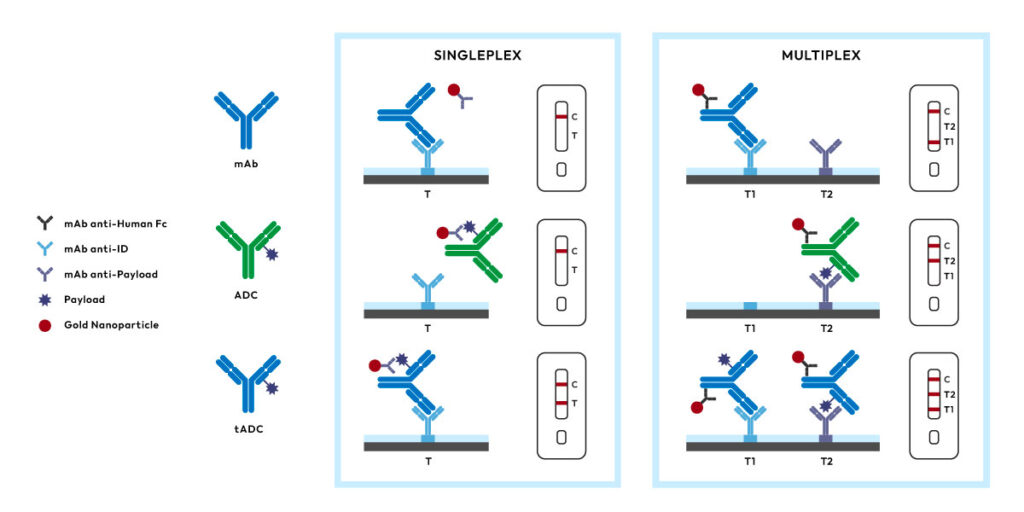
Detection of a target antibody-drug conjugate (tADC) using a Simpleplex LFA – The assay is based on a sandwich immunoassay employing anti-idiotype (anti-ID) capture antibodies and anti-payload gold conjugates for detection. Only the tADC generates a positive test line, ensuring high specificity.
Detection of a tADC and its subcomponents using a Multiplex LFA – This format expands detection capabilities by incorporating a generic anti-human IgG Fc gold conjugate for detection. As a result, the unconjugated monoclonal antibody (mAb) produces only the T1 test line, an ADC carrying the same payload but a different mAb produces only the T2 test line, and the tADC simultaneously generates both T1 and T2 test lines, enabling discrimination between the tADC and related molecules.
Singleplex LFAs use one reagent directed against the antibody and another directed against the payload. A positive result is generated only when both recognize the same molecule, providing rapid qualitative confirmation that the intended ADC is present. This straightforward design is well suited to many routine manufacturing applications but offers limited information when products share common antibodies or payloads.
Multiplex LFAs provide greater discrimination by using independent capture lines for the antibody and payload. This allows each component to be evaluated separately, improving specificity in facilities manufacturing multiple related ADCs.
Neither format replaces orthogonal analytical methods. Quantitative measurements such as drug-to-antibody ratio (DAR), linker stability, and detailed molecular characterization remain the role of LC-MS and other laboratory-based techniques. Instead, LFAs complement these methods by providing rapid identity confirmation directly within manufacturing operations.
Like all analytical technologies, LFAs have limitations. In the platform shown above, free payload lacking an antibody Fc region cannot be detected, and engineered Fc mutations may create interferences requiring alternative detection strategies. These considerations reinforce an important principle: successful identity testing depends not only on the technology, but also on thoughtful assay design and portfolio management.
PRO TIP: Planning for Success
The effectiveness of an ADC identity test is often determined long before GMP validation begins. Manufacturers should consider several questions early in development:
- Will the portfolio include ADCs sharing antibodies or payload platforms?
- Is rapid qualitative identity confirmation sufficient, or are quantitative methods also required?
- When should anti-idiotype reagent development begin to avoid downstream delays?
Addressing these questions early allows assay architecture, validation strategy, and manufacturing workflows to evolve together rather than independently.
Conclusion
ADCs have changed the requirements for identity testing. Unlike conventional monoclonal antibodies, they require manufacturers to confirm two independently variable molecular components within a single therapeutic product while distinguishing that product from an increasingly complex portfolio of related molecules.
Lateral flow immunoassays are uniquely positioned to support this need. When thoughtfully designed, they provide rapid, robust identity confirmation that complements traditional analytical methods while fitting naturally into GMP manufacturing workflows.
Choosing the appropriate LFA format is therefore more than a technical decision. It is a strategic one. Decisions about assay architecture, reagent selection, and specificity planning influence validation effort, manufacturing efficiency, and the ability to support future ADC programs.
At BioAssay Works, we partner with biopharmaceutical manufacturers early in development to design lateral flow identity assays that are fit for purpose today and scalable for tomorrow’s portfolio. If your organization is developing or manufacturing ADCs, early planning can simplify validation, reduce implementation risk, and position your identity testing strategy for long-term success.