
Biotherapeutic Identity Testing: From Novel Concept to Mission-Critical Manufacturing Requirement
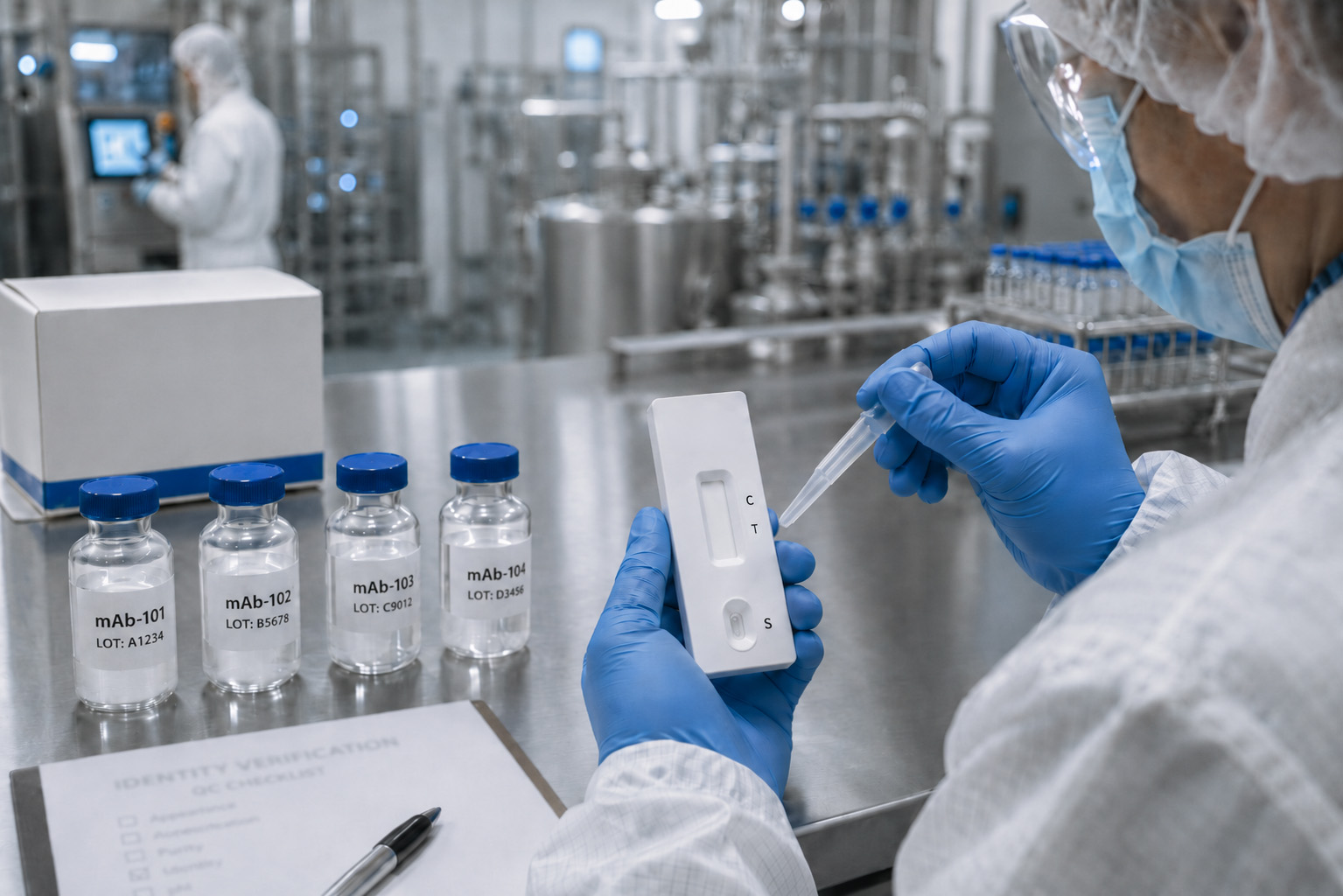
When BioAssay Works and AstraZeneca published a landmark paper in the Journal of Immunological Methods in 2019, lateral flow assays for biotherapeutic identity testing were still a novel concept — promising, but largely unproven at scale. Six years later, identity testing is a standard procedure in biopharmaceutical manufacturing, the number of biologics requiring such tests has multiplied dramatically, and the tools available to perform them have advanced considerably. This article traces that evolution: where it started, where it stands today, and where it is heading.
A Proof of Concept That Held Up
In 2019, BioAssay Works partnered with AstraZeneca to solve a problem many manufacturers still struggle with today: how to confidently distinguish between structurally similar biologics in real-world manufacturing environments. Under 21 CFR § 610.14, the FDA requires that the contents of a final container of each filling of each lot be tested for identity, and that the test be specific for each product in a manner that will adequately identify it and distinguish it from any other product being processed in the same facility. For monoclonal antibody (mAb) products, that means the test must be specific; able to confirm not just that an antibody is present, but exactly which one.
The result: a lateral flow platform capable of distinguishing highly similar monoclonal antibodies with zero false positives across large comparator panels, validated for real manufacturing use. Seven identity-specific assays were developed and verified against 10 to 40 other antibody products; three were validated for lot release in accordance with ICH guidelines. More importantly, the approach scaled — new assays could be developed and deployed as product portfolios expanded.
A link to the paper is available at Science Direct.
Why This Matters Now
The number of biologics in development and production has exploded, creating a new operational burden for manufacturing teams. The global monoclonal antibody therapeutics market stood at approximately $252 billion in 2024 and is projected to approach $500 billion by 2029, with broader market projections encompassing biosimilars and novel biologic formats pointing well beyond that figure. While each new biologic doesn’t just require its own identity test, it does increase the complexity of every existing one. Manufacturing sites must now distinguish each product from an expanding portfolio under real-world conditions.
Lateral flow assays have emerged as a practical solution because they move testing closer to the point of production, reducing delays and dependency on centralized labs. Speed, simplicity, and deployability have made them a credible and increasingly preferred option across global manufacturing operations. Regulatory frameworks, including guidance from the FDA and ICH, have increasingly accommodated LFA-based methods as part of validated testing programs, further accelerating adoption at manufacturing sites worldwide.
From Cobbled-Together Tools to Turnkey Kits
Historically, implementing LFA-based identity testing required specialized lab expertise, manual dilutions of 1:1,000 to 1:2,500 and multiple pipetting steps, limiting adoption in manufacturing environments. Today, that barrier has been removed. Identity testing can be deployed as standardized, self-contained kits, enabling consistent execution by manufacturing personnel across global sites: pre-filled dilution tubes, integrated sample collection devices, and dropper applicators that eliminate the need for additional equipment.
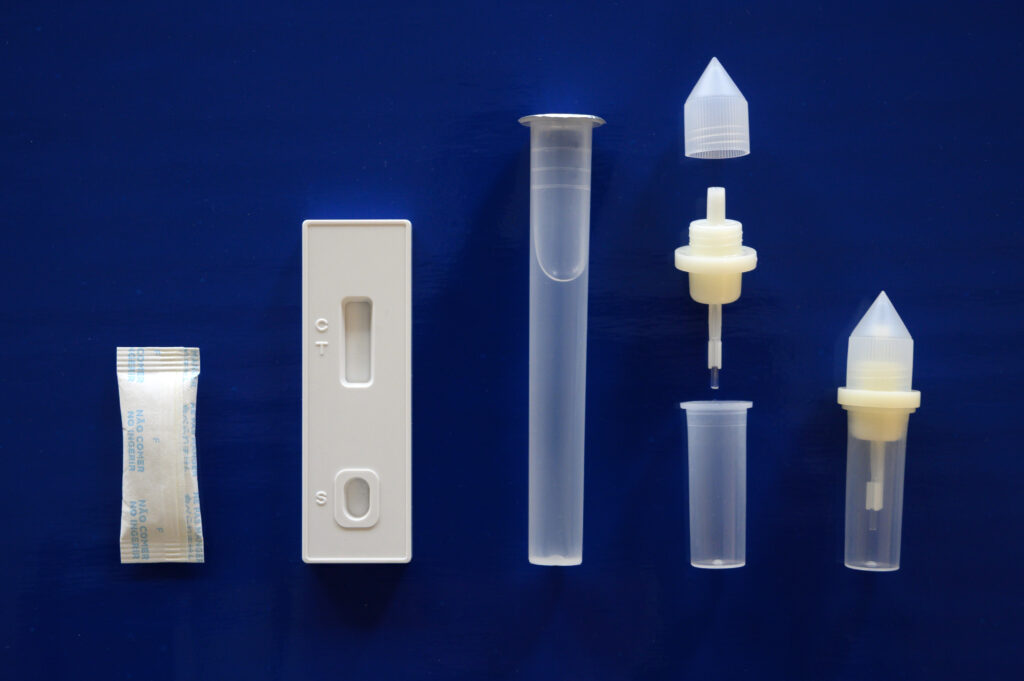
BioAssay Works has seen this shift reflected in our own work. An increasing proportion of the kits we develop are delivered with all consumables included. Customers receive a complete solution designed to minimize variability and simplify deployment across global manufacturing sites.
The New Frontiers: Modified Biotherapeutics, Specificity Challenges, and Quantitation
The biotherapeutics now populating pharmaceutical pipelines are structurally more complex than conventional mAbs, and identity testing must evolve with them. We will explore each of these emerging areas in depth in future articles; below is a summary of the key developments.
Modified Biotherapeutics
- Antibody Drug Conjugates (ADCs) link a targeting antibody to a chemotherapy payload, requiring identity confirmation of both components — not just the antibody.
- More than 15 FDA-approved ADC products are on the market, with global sales projected to exceed $24 billion by 2030.
- On the horizon: bispecific ADCs that bind two different antigens simultaneously, bringing yet another layer of complexity to identity testing requirements.
The Growing Burden of Specificity
- Unlike most LFA applications, biotherapeutic identity testing is a specificity problem, not a sensitivity problem: the molecule is present in abundance; the challenge is proving exactly which one it is.
- What used to require differentiation across 10–15 molecules now often requires 30 or more within the same manufacturing environment.
- Building high-specificity assays at this scale requires accumulated knowledge that is difficult to develop without repeated, real-world validation experience — precisely what clients acquire when they partner with BioAssay Works.
Quantitative In-Process Testing
- Manufacturing increasingly demands more than a yes/no identity confirmation — real-time concentration data is becoming operationally necessary.
- Advances in handheld readers and validated smartphone-based applications now allow LFA-based tests to deliver quantitative results at the point of production.
- Real-time yield monitoring allows teams to identify deviations earlier, reducing the risk of batch failures and the costly delays they create.
PRO TIP: Signs Your Identity Testing Approach May Need to Evolve
- Your biologics portfolio is expanding, increasing cross-reactivity risk
- Your current methods are struggling to scale as the portfolio grows or manufacturing sites multiply
- Manufacturing sites require standardized, transferable testing solutions
- Real-time or in-process concentration data has become operationally necessary
What Has Not Changed
The core insight from 2019 still holds: a lateral flow immunoassay is an ideal analytical tool for biotherapeutic identity testing; rapid, portable, easily transferred across global sites, and adaptable to new products as pipelines grow. What has changed is the scale and complexity of the problem. More approved biologics, more complex molecular formats, higher specificity expectations, and growing demand for quantitative data have raised the bar considerably.
At BioAssay Works, identity testing for biotherapeutics is not a new offering — it is a practice built and refined over years of real-world development and validation work. The pace of change in this space is not slowing. Neither are we. If you are establishing or expanding an identity testing program for your biopharmaceutical products, we invite you to contact us.