
LFA vs ELISA: How to Choose the Right Diagnostic Method (Sensitivity, Speed & Use Case)
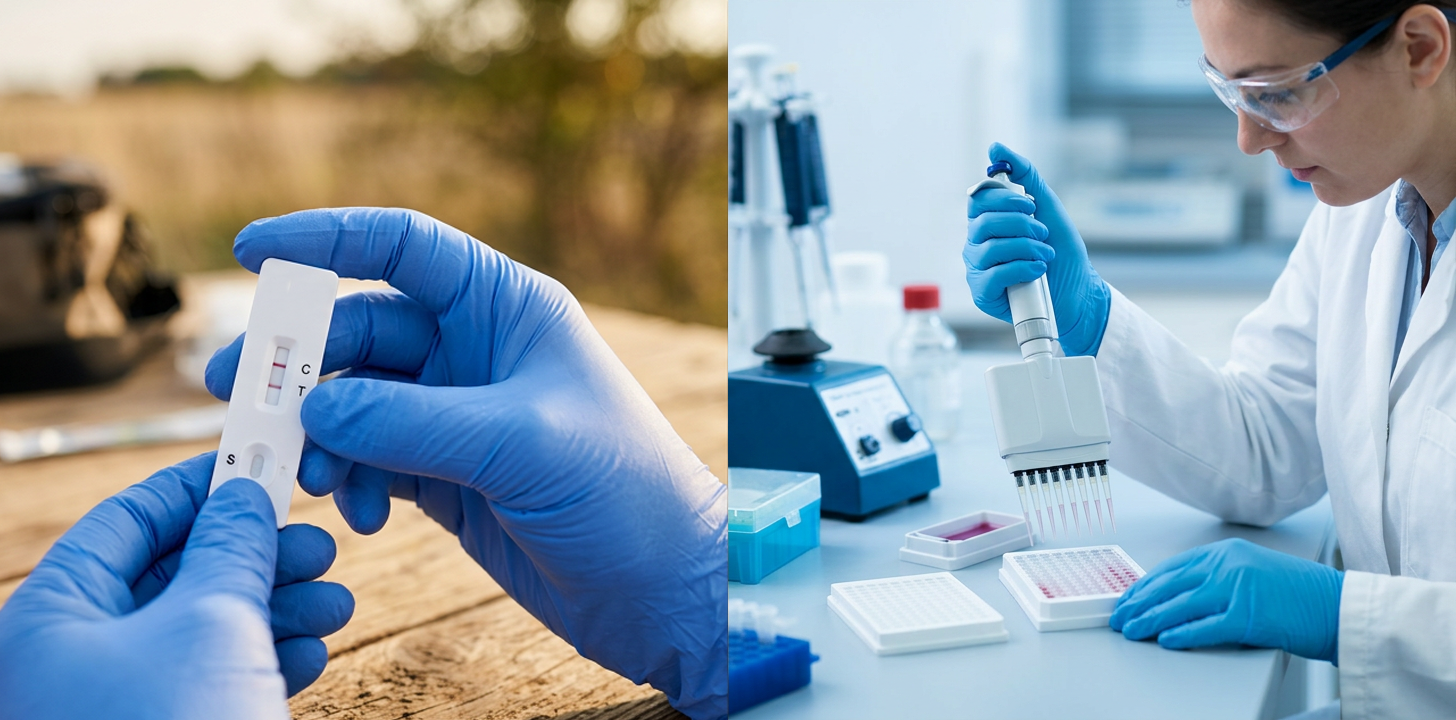
Lateral flow assays (LFA) and enzyme-linked immunosorbent assays (ELISA) are widely used immunoassay techniques. Choosing the right method depends on application, sensitivity, and environment. Both methods have been around for over 50 years, and each has earned a well-deserved place in diagnostics. But they are not interchangeable — ELISA offers high sensitivity, while LFA provides rapid results. Understanding where each excels is critical to selecting the right tool for your application.
Head-to-Head: LFA versus ELISA at a Glance
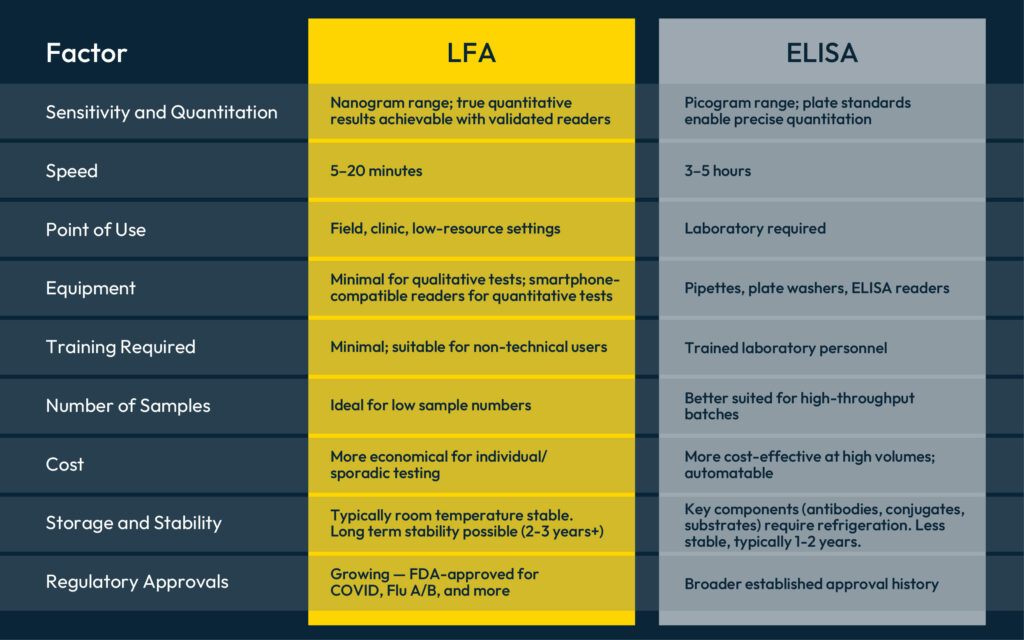
LFA vs ELISA Sensitivity, Speed, and Cost Explained
Sensitivity and Quantitation are closely linked and perhaps the most cited distinctions between the two methods. ELISAs can detect targets at the picogram level in the final prepared sample; LFAs typically achieve detection in the nanogram range. Both figures refer to the concentration after any sample dilution — an important distinction in practice. A target present at 5 ng/mL in blood, for example, effectively moves into the picogram range after a 1:10 dilution, potentially placing it beyond the detection range of an LFA. Knowing the native concentration of your target in its original matrix — and the dilution your sample may require — is an essential early consideration in method selection.
ELISA is aided by multi-step amplification, extended incubations, and in-plate controls that correct for variables like temperature and incubation times. This makes ELISA the established benchmark for precise quantitation. LFAs detection in the nanogram range is shaped by the shorter immunodetection window and the absence of washing or amplification steps.
That said, LFA quantitation has advanced considerably, driven in large part by the rapid innovation of the COVID-19 era. Modern LFAs paired with validated readers can deliver true quantitative results using established regression curves, without the plate-level complexity that makes ELISA impractical outside a laboratory. For most point-of-care applications where targets are present at nanogram levels or higher, today’s quantitative LFAs are capable of meeting clinical and regulatory requirements.
Point of use is where LFAs truly differentiate themselves. An ELISA requires a laboratory environment with controlled conditions, trained personnel, and a significant capital investment in equipment. LFAs can be run in the field, in a clinic, in a manufacturing facility, on a farm, or in any low-resource setting. With smartphone-compatible readers increasingly available, even true- or semi-quantitative results are now achievable without traditional lab infrastructure. As an example, Preventis SmarTest Calprotectin Home monitors inflammatory bowel diseases (IBD) using an LFA and cellphone app. This makes LFAs uniquely suited to point-of-care and point-of-use applications where proximity to the sample or the patient matters.
Throughput and cost favor each method in different contexts. ELISAs can be automated and are more economical when processing large volumes of samples. LFAs are more cost-effective for individual, sporadic, or field-based testing where plating hundreds of samples at once simply isn’t practical.
Regulatory approvals have historically favored ELISAs, but the gap is closing rapidly. The COVID-19 pandemic accelerated FDA clearance of LFAs dramatically, and approved tests for Flu A/B, RSV, Strep, drug toxicology, COVID, and other targets are now part of a growing list. USDA has approved tests for avian influenza, swine influenza, aflatoxins in grain, and food pathogens.
Choosing the Right Diagnostic Method for Your Application
Both methods are excellent — selecting the right one depends on the requirements of your specific application and end user
Choose an LFA when:
- Results are needed immediately
- Testing occurs at the point of care or in the field
- Low-resource or non-laboratory settings are involved
- The target analyte is present at nanogram levels or higher
- Simplicity and ease of use for non-technical operators are priorities
Choose an ELISA when:
- High sensitivity or precise quantification is essential
- Large sample volumes require high-throughput processing
- On-plate calibration controls are required
- A fully equipped laboratory setting is available
At BioAssay Works, our expertise is in lateral flow assay development — from gold conjugation and assay design to manufacturing and scale-up. If you’re weighing your options, a feasibility assessment can help you determine whether an LFA is the right fit for your application, your end users, and your path to market.